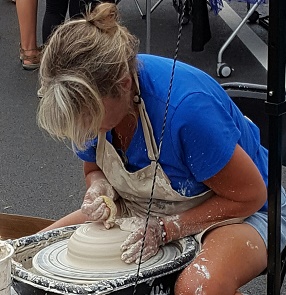
Hand-building refers to any method of constructing ceramic forms without a wheel. It predates wheel-throwing by thousands of years and remains a central technique in contemporary studio ceramics. For a beginner, hand-building offers a more direct relationship with the material — mistakes are visible immediately and corrections are made by hand rather than through the coordination of wheel speed, water, and pressure simultaneously.
The three core methods are pinch, coil, and slab. Each produces different forms, requires different drying management, and has characteristic failure points that are worth understanding before starting a piece.
Pinch Pots: Direct Contact with Clay
A pinch pot starts with a ball of clay — typically 200–500g for a beginner's first attempt. The thumb is pressed into the centre of the ball to roughly 1cm from the base, and the walls are opened by pinching outward in rotating increments, rotating the piece constantly between presses.
The technique develops sensitivity to wall thickness before any other method. Because both the inside and outside surface are accessible to the fingers, it is easy to feel where the wall is too thick or too thin without measuring. Most instructors in Polish ceramics courses begin with pinch pots for exactly this reason.
Common Problems in Pinch Construction
- Cracking at the rim: caused by working clay that has dried too quickly or thinning the rim unevenly. Solution: keep a damp sponge nearby and maintain consistent wall thickness from base to rim.
- Uneven base: caused by thinning walls without supporting the base. Solution: hold the piece in the palm of one hand, which allows you to feel when the base is beginning to thin excessively.
- S-crack in the base: a diagonal crack that appears after drying, caused by centripetal stress during construction. Solution: compress the base firmly in circular motions at the beginning of every pinch session.
Two pinch forms can be joined together to make enclosed shapes — spheres, oval vessels, or closed sculptural forms. The seam is scored and slipped on both surfaces before pressing together, then blended on the outside. Joining two pinch halves while the clay is still plastic (leather-hard joins are possible but less reliable) gives the best structural result.
Coil Construction: Building Upward
Coil construction involves rolling clay into long cylinders — roughly 1–2cm in diameter for most beginner projects — and stacking them to build walls. The coils are blended on the inside surface to create a continuous wall; the outside can be left textured or smoothed depending on the intended surface treatment.
Coil building is slower than slab work but produces forms with more natural, organic profiles. It is well suited to large vessels, sculptural pieces, and forms where symmetry is not the goal. Many contemporary Polish ceramic artists working in vessel forms use coil construction for pieces above 40cm in height, where a wheel would require advanced throwing skills to achieve comparable results.
Blending Coils Correctly
The inside surface of a coil-built wall must be blended into a continuous clay mass. Unblended coils remain as separate layers and will separate during drying or firing. The standard method is to drag a finger or wooden rib upward along the inside surface, pressing each coil into the one below it. Two or three passes per coil is usually sufficient.
The outside surface can be blended or left showing coil texture. If the piece will be glazed with a smooth glaze, surface texture from coils may telegraph through — in that case, scraping the outside with a metal rib when the clay is leather-hard gives a cleaner surface.
Controlling Drying in Tall Coil Pieces
Tall coil-built pieces need controlled drying. The base dries faster than upper coils, which can cause differential stress and cracking. Covering the base and lower half with plastic while the upper coils are added slows the drying rate of the early sections and keeps the whole piece at a more uniform moisture content. In summer in Poland, where studio temperatures can exceed 25°C, this becomes critical for pieces taller than 30cm.
Slab Construction: Flat Forms and Angular Geometry
Slab building starts by rolling clay flat — a rolling pin and two guide sticks of equal thickness produce a consistent slab. Common thicknesses for structural walls are 6–10mm. Thinner slabs are possible but require more support during construction and are more vulnerable to warping.
Slabs can be used soft (immediately after rolling) or allowed to firm to leather-hard before construction. Soft slabs drape, fold, and curve easily; leather-hard slabs hold their shape and make clean angular forms — boxes, tiles, architectural shapes. The decision between soft and leather-hard slab work determines the character of the finished piece more than almost any other choice in construction.
Joining Slab Walls
Slab joins are the critical technical point in this method. Both surfaces must be scored — scratched with a fork, a serrated rib, or a needle tool — then coated with slip (liquid clay of the same body) before pressing together. Slip is the adhesive, not a lubricant: the slip fills the scored grooves and the two surfaces are fused when compressed.
Corner joins in box forms are typically made at 90° with one slab butting against the edge of another, or with a mitre join for clean external edges. Butt joins are structurally reliable when scored and slipped properly; mitre joins require more care but produce a cleaner exterior line.
Preventing Slab Warping
Warping is the main failure mode in slab work. It occurs when slabs dry unevenly — one surface faster than the other, or the centre faster than the edges. Drying slabs on a porous bat (wooden board, concrete tile) rather than on plastic allows both surfaces to dry at a similar rate. For flat pieces like tiles, sandwiching between two boards with light weight during drying maintains flatness through to bone-dry stage.
Polish ceramic supplier catalogues include bat boards (deski do ceramiki) in sizes from 30×30cm to 60×90cm, which are standard studio equipment for slab work.
Combining Methods
Pinch, coil, and slab construction are not mutually exclusive. Many finished pieces combine all three: a slab base with coil walls and pinched detail elements, or a coil form with slab additions. The joins between methods follow the same scoring and slipping rules, with the additional consideration that pieces made by different methods may dry at different rates and need more careful moisture management.
Understanding all three methods before committing to one as a primary practice gives a clearer sense of what each is suited to. Most introductory ceramics courses in Poland, including those at Pracownia Ceramiki in Warsaw and Centrum Ceramiki Artystycznej in Kraków, cover all three methods in the first eight sessions.
Last updated: 18 April 2026. Content reflects standard ceramic practice in Poland as of that date.